
Le intelligenze artificiali nei luoghi della cultura: musei, archivi e biblioteche
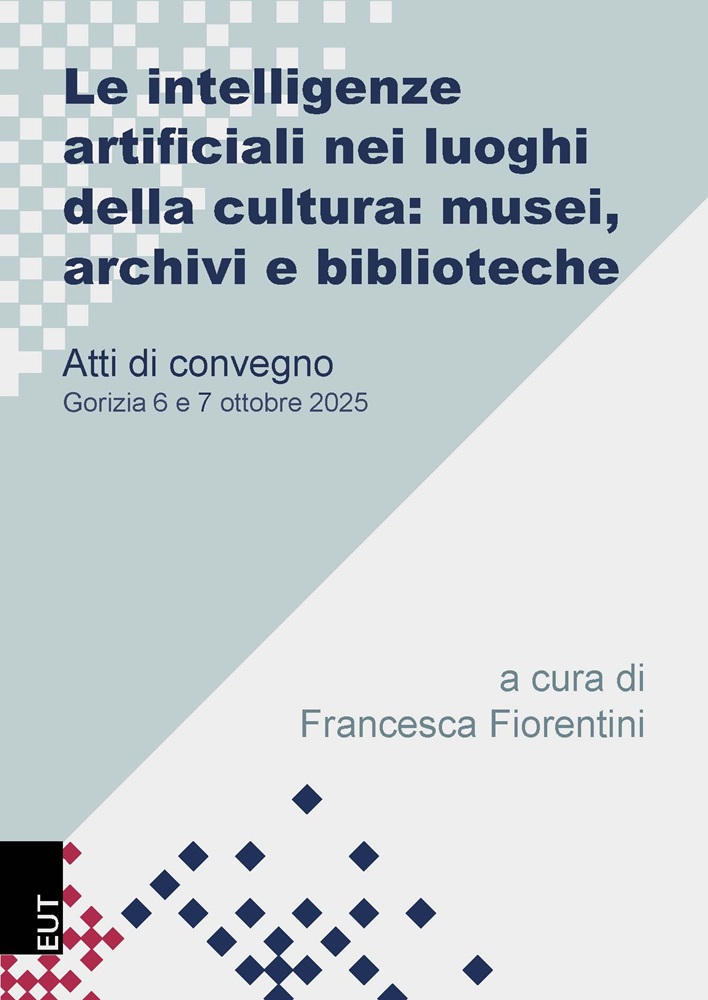
Le intelligenze artificiali nei luoghi della cultura: musei, archivi e biblioteche
Proceedings of the Conference, Gorizia, 6–7 October 2025
Edited by Francesca Fiorentini
EUT Edizioni Università di Trieste, 2026
ISBN 978-88-5511-863-7 (print) – e-ISBN 978-88-5511-865-1 (PDF)
This volume brings together the proceedings of the conference held in Gorizia on 6 and 7 October 2025, promoted by the University of Trieste Museum System (smaTs) and the Friuli Venezia Giulia chapter of MAB – Museums, Archives and Libraries, with the patronage of ERPAC FVG, the Municipality of Gorizia, and Assicurazioni Generali.
Edited by Francesca Fiorentini, coordinator of smaTs, the book examines artificial intelligences—deliberately rendered in the plural to reflect the diversity of technologies now converging on cultural heritage—within the traditional institutions of culture: museums, archives, and libraries. Interdisciplinary in scope, the contributions explore both the opportunities and the limitations of AI in heritage digitization, accessibility and user engagement, immersive storytelling, semantic enrichment, and emerging cultural professions, while also addressing the critical issues of data quality, bias, and ethical governance.
The second part of the volume—devoted to Artificial Intelligence Applications in the Cultural Sector—includes a contribution by the Generali Historical Archive entitled Innovation Applied to Cultural Heritage.
The essay presents the integrated digital ecosystem adopted by the Group for the management of its heritage assets: from the open-source cataloguing platform xDams, aligned with international standards (ISAD(G), Records in Contexts, EAD3, EAC-CPF and Dublin Core), to the IIIF-based digital library, and, more recently, to full-text search projects enabled by OCR (Optical Character Recognition) and handwritten-text recognition through HTR (Handwritten Text Recognition). It also discusses the adoption of Transkribus for training customized models on nineteenth-century handwriting and specialized insurance terminology. The contribution thus offers a concrete example of how established archival practices, open technologies, and AI tools can be integrated in support of knowledge creation and public engagement, in keeping with the mission of the Generali Historical Archive—recognized by the Italian Ministry of Culture as a cultural asset of historical significance—to ensure that heritage remains not a repository of memories, but a living resource.
The volume is available in print (€15.00) and as an open-access digital edition under a Creative Commons CC BY-NC-ND 4.0 license, available for online consultation and download at this link.