
The Lighthouse that Illuminates the Vastness: The Generali Prague Lighthouse
23 February 2026
Historical Archive Generali
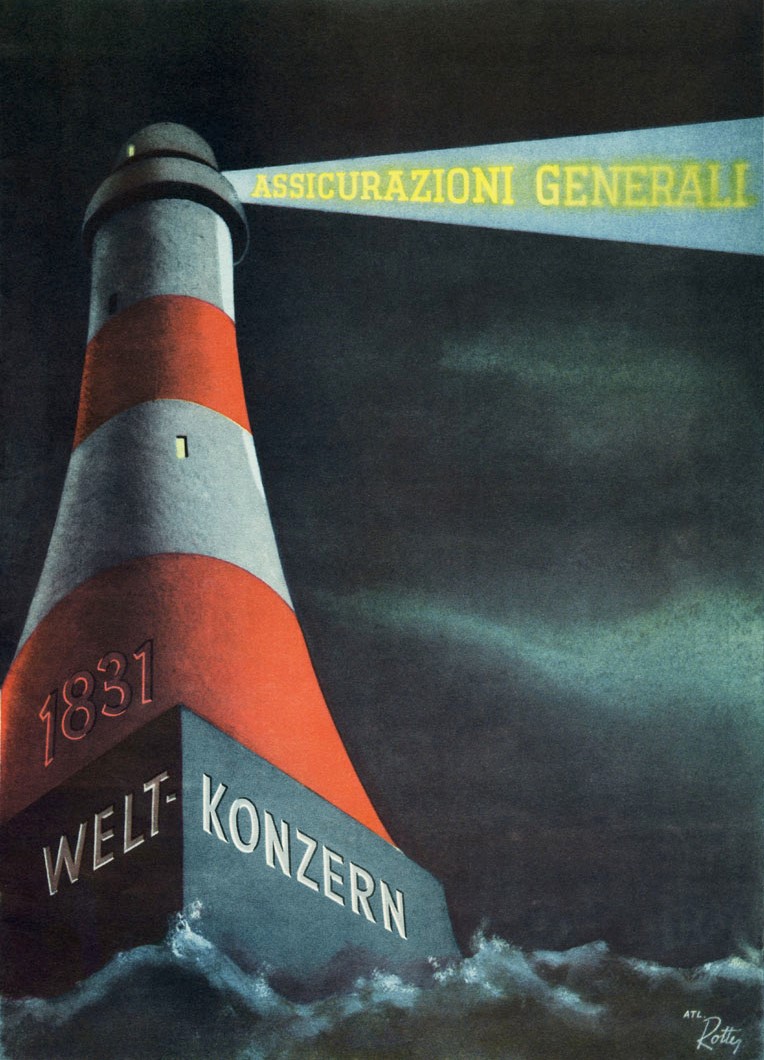
There’s a famous image that stands out in Generali’s visual history: the lighthouse designed for the cover of the Generali Prague corporate magazine.
While it’s often thought of as a poster, in actual fact the drawing appears as the cover of the 1936-1938 issues of the Czech subsidiary’s magazine, after which it is likely that the magazine was no longer published: the first sign of which is that the historical archive and the company’s central library retain more copies of those years.
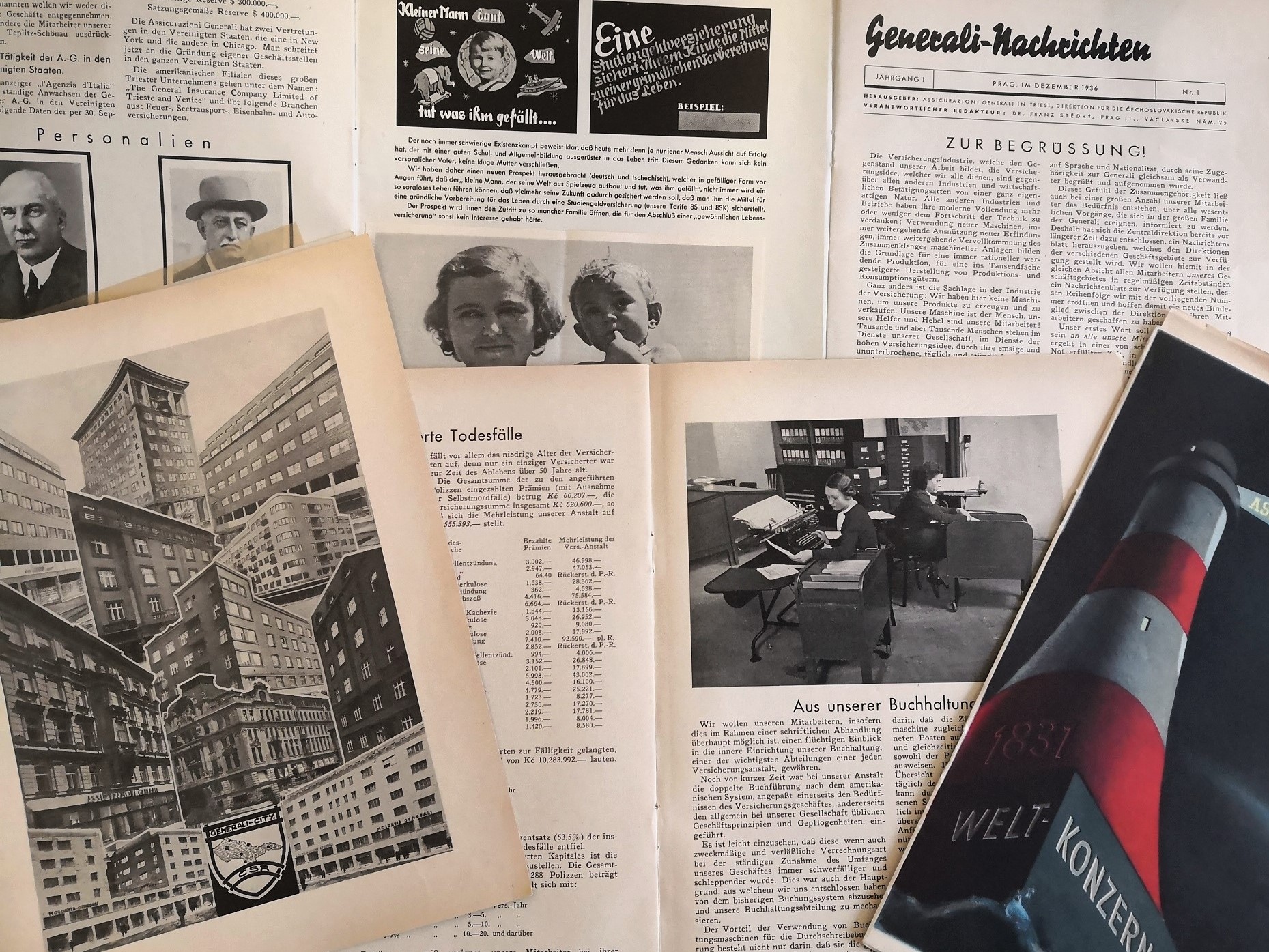
There were lofty expectations of the magazine, evidenced not only by the statement of intent by its editor-in-chief, Franz Ště́drý (to create a useful mechanism to provide regular updates on insurance matters, and cohesion between the head office and its partners by providing information “on all the important events taking place within the wider Generali family” along the lines of the Bollettino, the Generali company magazine), but also the decision to employ the services of the renowned Orbis printing press in Prague, and one man in particular: the illustrator and advertising graphic designer Wilém Rotter (Brno 1903 - London 1978).
The illustrious name whose signature was attached to the project can be seen through a careful examination of the signature that appears at the bottom right of the cover of the magazine: «ATL. Rotter».
Rotter was an advertising graphic designer and the founder of one of the most important pre-war artistic studios of Prague, Atelier Rotter, and a private art school, Rotter’s School, attended by a host of famous artists.
Back in the early 1930s, Atelier Rotter was the biggest advertising studio in Prague (as well as commercial advertising for large companies, he also designed promotional materials for small producers and retailers, sporting and entertainment events, record companies, film and theatre productions) that employed dozens of employees: so, it was no coincidence that Generali Prague chose him to promote its house organ.
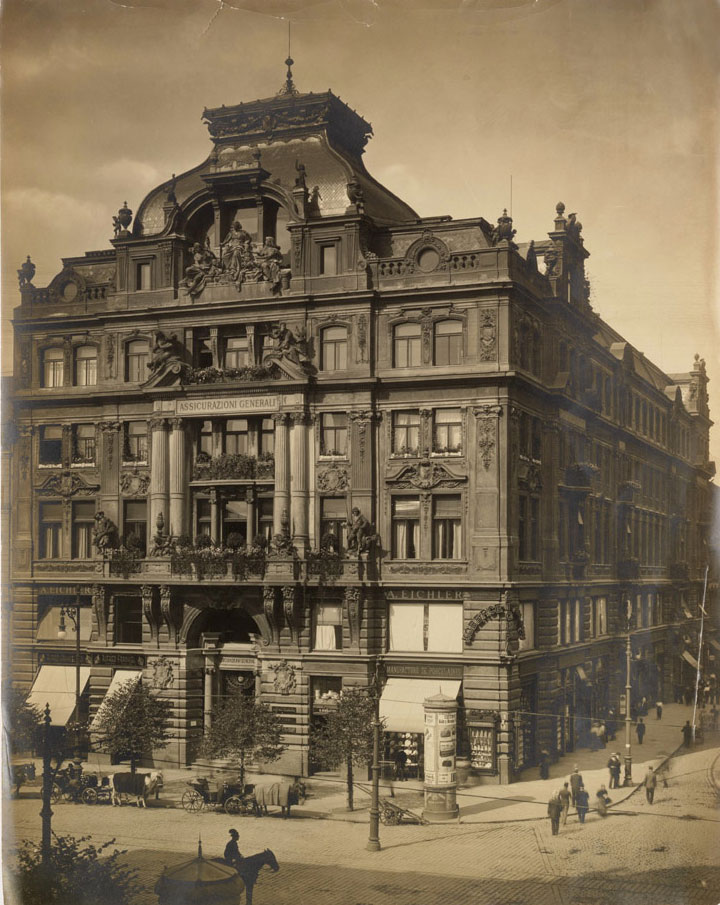
After all, this was Prague, one of the great capitals of Europe, and a headquarter of one of the most prominent global insurance companies: Generali. Over a hundred employees worked here in the early 1900s, among them a young law student: Franz Kafka. Opened in 1832, the office was responsible for numerous breakthroughs. In 1884, the first women were employed there (a successful experiment that was extended to the Trieste headquarters in 1892); it was also the first Generali office within a purpose-built modern building, designed and constructed from 1894 to 1896 under the watchful eye of Eugenio Geiringer), to meet the specific needs of the company.
The pieces in the magazine, written in German, were also of a high level: they ranged from more technical articles on insurances, with texts edited by the editor-in-chief, Ště́drý, himself, or by in-house collaborators (articles credited by first and last initials) to articles on social security, curated by outside collaborators. There is no shortage of quirky stories and general news regarding the company or life in the Prague office.
The years following Hitler’s occupation of Czechoslovakia in 1938 were difficult. Years of political and territorial demands and racial discrimination, with no relief for the protagonists of this story: another data point for the theory that the magazine had a short lifespan and the editions in the archive were the only ones published.
Wilém Rotter was Jewish, but he was able to flee abroad during the war. Throughout this period, he produced posters for the Belgian Ministry of Information from London, creating a name for himself, to the extent that he was regularly lauded in the English press as one of the most influential designers of the 1950s.
Building a network, creating strong ties between the headquarters and the field offices, the importance of being part of a community; Ště́drý understood this all too well, and it was this spirit of belonging that drove him to establish Generali-Nachrichten (lit. Generali-News), as he explained in the first edition, and to “look ahead”, shed light and bring clarity to complicated topics such as insurance, which had to keep pace in a constantly evolving market.
This may be where the idea of the lighthouse image comes from; a metaphor for communication in the broad and general sense – the action of casting light for others, as a source of knowledge.
In the poem Mattina (“Morning”), Giuseppe Ungaretti is able to describe man’s desire for immensity in one line: “I illuminate myself with immensity”. The morning represents the moment of rebirth and renewal of life’s flow, and the immensity is the space, the horizon ahead of every living being. Vast beyond belief, to the extent that it is only by closing our eyes that we are able to extend our arms to the full distance of its incalculable length. And it is in those arms outstretched to infinity that we find the link between the eternal and the ephemeral, that most mysterious of connections that man constantly relives throughout the course of life, that the poem references.
The same is true for the archival research, with one significant difference: in those outstretched arms there is a link to the eternal, which can be understood as the history, but not the ephemeral. Rather, it is something incredibly tangible: a document from which knowledge is drawn.