
Statua giacente su un piano, 1942-1944
Mario Sironi (Sassari 1885 - Milan 1961)
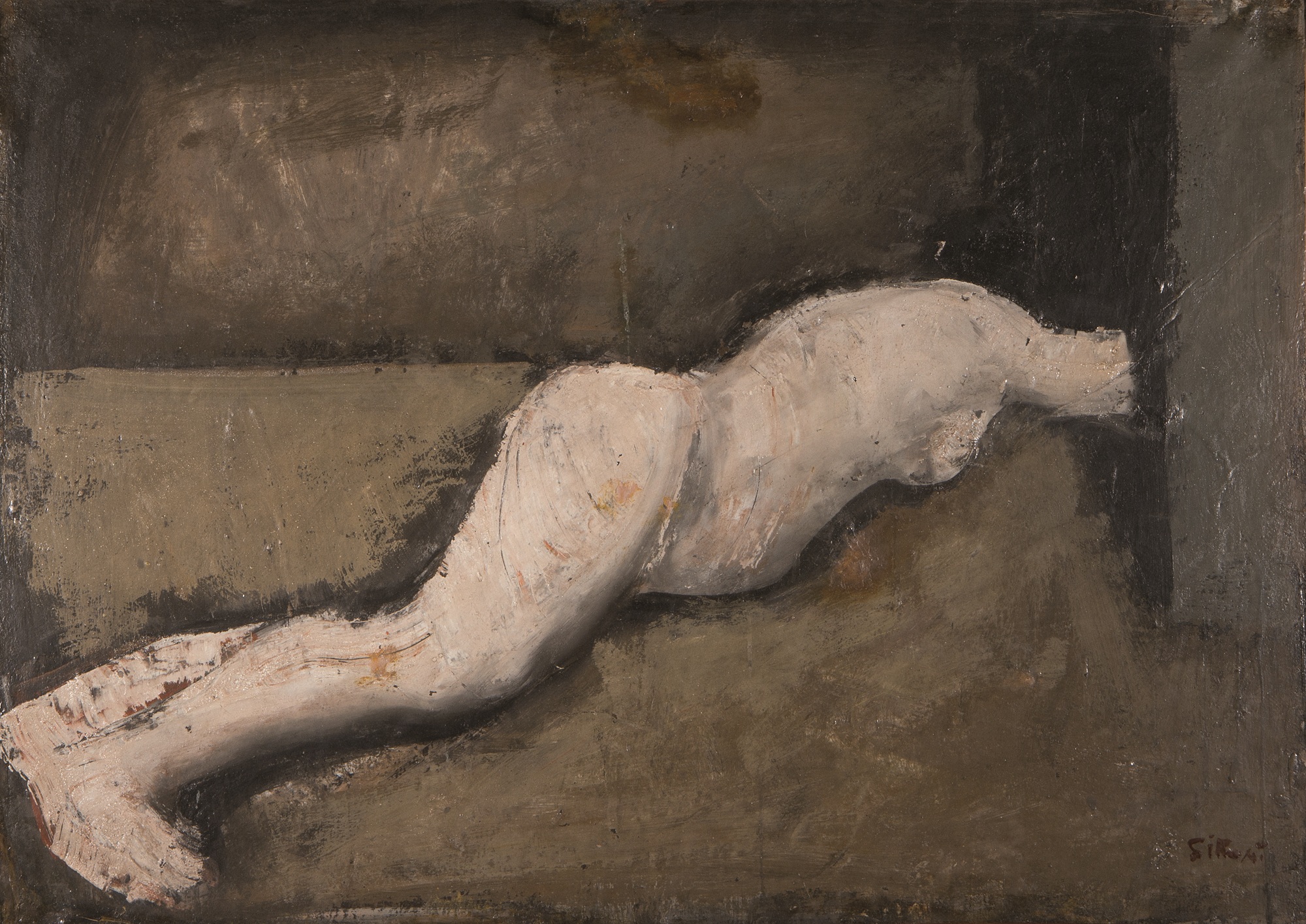
Statua giacente su un piano
gouache on paper laid down on canvas
1942-1944
cm 68,5 x 96
Mario Sironi is renowned as one of the founders of the Novecento artistic movement in Milan. In addition to painting, he distinguished himself as a sculptor, architect, illustrator, set designer, and graphic artist.
His artistic training began in Rome, where he lived until 1919. Following the premature death of his father, Sironi completed his technical studies and devoted himself to drawing. In 1902 he enrolled in the Faculty of Engineering, but soon abandoned his studies, partly as a result of a depressive crisis, the manifestation of an existential unease that would accompany him throughout his life. He therefore chose to dedicate himself to art and enrolled at the Scuola Libera del Nudo, where he met Umberto Boccioni, Gino Severini, and Giacomo Balla, with whom he established a lasting artistic association.
Immersed in the writings of Nietzsche and Schopenhauer and inspired by the music of Wagner, he moved within a Roman milieu steeped in social idealism, passing through a number of artistic phases: from the Secessionism of his youth to the Divisionism of the early twentieth century; from the pre-war Futurism shaped by friends and colleagues such as Boccioni and Severini to the German Expressionism he encountered during his travels in Germany (1908, 1910-1911).
During the 1920s, he established himself as a major painter, participating in exhibitions and receiving recognition both nationally and internationally. His style evolved towards a monumental realism, developing a highly evocative material expressionism, with works depicting urban landscapes and human figures through a powerful formal synthesis. He settled permanently in Milan, where in 1920 he drafted the Manifesto contro tutti i ritorni in pittura (Manifesto Against All Returns in Painting), the theoretical cornerstone of his own “return to order,” achieved also through the formal innovations of Futurism.
In the 1930s, he devoted himself to the creation of monumental works, including frescoes, mosaics, and architectural schemes, while also pursuing a public role as an illustrator for newspapers and magazines and as artistic director of major events of the period.
During the war years, he revisited certain formal elements of his Metaphysical period, though interpreted through a more materially textured mode of painting, which in the 1940s and 1950s would develop into an expressionism bordering at times on tendencies associated with Informal art. These characteristics can be found in Statua giacente su un piano (Recumbent Statue on a Plane).
The subject depicts an ancient female statue lying fallen on the ground. This reflects Sironi’s conception of antiquity as an ideal to be grasped through its archaic morality, bringing together the purity of the Greeks, the stylisation of the Byzantines, the monumentality of the Romans, and the spirituality of the Romanesque and Gothic worlds. The work should be dated between 1942 and 1944, when the artist revisited themes and motifs from his Metaphysical period. The compressed spaces, rendered with a clarity that lends the shadows the solidity of a wall, together with the smooth, palette-worked surfaces articulated by contour lines, place the painting at the end of the Second World War. The fallen statue, too, may carry a symbolic meaning, at a moment when Sironi saw the world in which he had believed crumble before him: the dream of a vanquished classicism, brought low like his own now unattainable ideals of a great monumental and socially engaged art.